Entrance Antiphon
O people of Sion, behold,
the Lord will come to save the nations,
and the Lord will make the glory of his voice heard
in the joy of your heart.
First Reading: Isaiah 11:1-10. A reading from the prophet Isaiah
He judges the poor with justice.
A shoot springs from the stock of Jesse,
a scion thrusts from his roots:
on him the spirit of the Lord rests,
a spirit of wisdom and insight,
a spirit of counsel and power,
a spirit of knowledge and of the fear of the Lord.
(The fear of the Lord is his breath.)
He does not judge by appearances,
he gives no verdict on hearsay,
but judges the wretched with integrity,
and with equity gives a verdict for the poor of the land.
His word is a rod that strikes the ruthless,
his sentences bring death to the wicked.
Integrity is the loincloth round his waist,
faithfulness the belt about his hips.
The wolf lives with the lamb,
the panther lies down with the kid,
calf and lion cub feed together
with a little boy to lead them.
The cow and the bear make friends,
their young lie down together.
The lion eats straw like the ox.
The infant plays over the cobra’s hole;
into the viper’s lair
the young child puts his hand.
They do no hurt, no harm,
on all my holy mountain,
for the country is filled with the knowledge of the Lord
as the waters swell the sea.
That day, the root of Jesse
shall stand as a signal to the peoples.
It will be sought out by the nations
and its home will be glorious.
Responsorial Psalm: Justice shall flourish in his time, and fullness of peace for ever.
- O God, give your judgement to the king,
to a king’s son your justice,
that he may judge your people in justice
and your poor in right judgement. (R.)
- In his days justice shall flourish
and peace till the moon fails.
He shall rule from sea to sea,
from the Great River to the earth’s bounds. (R.)
- For he shall save the poor when they cry
and the needy who are helpless.
He will have pity on the weak
and save the lives of the poor. (R.)
- May his name be blessed for ever
and endure like the sun.
Every tribe shall be blessed in him,
all nations bless his name. (R.)
Second Reading: Romans 15:4-9. A reading from the letter of St Paul to the Romans
Christ, the hope of all people.
Everything that was written long ago in the scriptures was meant to teach us something about hope from the examples scripture gives of how people who did not give up were helped by God. And may he who helps us when we refuse to give up, help you all to be tolerant with each other, following the example of Christ Jesus, so that united in mind and voice you may give glory to the God and Father of our Lord Jesus Christ.
It can only be to God’s glory, then, for you to treat each other in the same friendly way as Christ treated you. The reason Christ became the servant of circumcised Jews was not only so that God could faithfully carry out the promises made to the patriarchs, it was also to get the pagans to give glory to God for his mercy, as scripture says in one place: For this I shall praise you among the pagans and sing your name.
Gospel Acclamation: Alleluia, alleluia! Prepare the way of the Lord, make straight his paths: all people shall see the salvation of God. Alleluia!
Gospel: Matthew 3:1-12. A reading from the holy Gospel according to Matthew
Repent, for the kingdom of heaven is close at hand.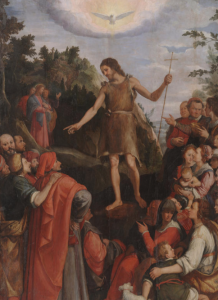
In due course John the Baptist appeared; he preached in the wilderness of Judaea and this was his message: ‘Repent, for the kingdom of heaven is close at hand.’ This was the man the prophet Isaiah spoke of when he said:
A voice cries in the wilderness:
Prepare a way for the Lord,
make his paths straight.
This man John wore a garment made of camel-hair with a leather belt round his waist, and his food was locusts and wild honey. Then Jerusalem and all Judaea and the whole Jordan district made their way to him, and as they were baptised by him in the river Jordan they confessed their sins. But when he saw a number of Pharisees and Sadducees coming for baptism he said to them, ‘Brood of vipers, who warned you to fly from the retribution that is coming? But if you are repentant, produce the appropriate fruit, and do not presume to tell yourselves, “We have Abraham for our father,” because, I tell you, God can raise children for Abraham from these stones. Even now the axe is laid to the roots of the trees, so that any tree which fails to produce good fruit will be cut down and thrown on the fire. I baptise you in water for repentance, but the one who follows me is more powerful than I am, and I am not fit to carry his sandals; he will baptise you with the Holy Spirit and fire. His winnowing-fan is in his hand; he will clear his threshing-floor and gather his wheat into the barn; but the chaff he will burn in a fire that will never go out.’
Reflection
by Nick Brodie (Leo’s Lens)
‘The worth of our societies, and our own future,’ Pope Leo declares, ‘depends on the answers we give’ to situations where human equality, dignity, and opportunity are diminished. We are only truly as equal as our neighbour. Our dignity must be reflected in their dignity. And our opportunity should never be their disadvantage.
‘All the members of the People of God’, he says, ‘have a duty to make their voices heard’ wherever and whenever opportunity presents. We are all called ‘to point out and denounce such structural issues’ as homelessness, pollution, and other afflictions of our world.
Our faith demands that we do not keep silent in the face of injustice. After all, the Pope notes, ‘the Gospel message has to do not only with an individual’s personal relationship with the Lord, but also with something greater.’
Rather than simply praying to enter the Kingdom of God, we are called to help manifest it and bring it to others.
This calling, the Pope adds, requires ‘an attentiveness to others.’ Because ‘the poor have learned many things that they keep hidden in their hearts’, he says, we ‘certainly have much to gain from the source of wisdom that is the experience of the poor.’ We must always be open to listening to those in need and hearing their cries.
[Quotes from Apostolic Exhortation Dilexi Te, 4 October 2025: https://www.vatican.va/content/leo-xiv/en/apost_exhortations/documents/20251004-dilexi-te.html]