Entrance Antiphon
Save us, O Lord our God!
And gather us from the nations,
to give thanks to your holy name,
and make it our glory to praise you.
First Reading: Zephaniah 2:3; 3:12-13. A reading from the prophet Zephaniah
In your midst I will leave a humble and a lowly people.
Seek the Lord
all you, the humble of the earth,
who obey his commands.
Seek integrity,
seek humility:
you may perhaps find shelter
on the day of the anger of the Lord.
In your midst I will leave
a humble and lowly people,
and those who are left in Israel will seek refuge in the name of the Lord.
They will do no wrong,
will tell no lies;
and the perjured tongue will no longer
be found in their mouths.
But they will be able to graze and rest
with no one to disturb them.
Responsorial Psalm: Happy the poor in spirit; the kingdom of heaven is theirs!
- It is the Lord who keeps faith forever,
who is just to those who are oppressed.
It is he who gives bread to the hungry,
the Lord, who sets prisoners free. (R.)
- It is the Lord who gives sight to the blind,
who raises up those who are bowed down,
the Lord, who protects the stranger
and upholds the widow and orphan. (R.)
- It is the Lord who loves the just
but thwarts the path of the wicked.
The Lord will reign for ever,
Zion’s God, from age to age. (R.)
Second Reading: 1 Corinthians 1:26-31. A reading from the first letter of St Paul to the Corinthians
God has chosen what is weak by human reckoning.
Take yourselves, brothers, at the time when you were called: how many of you were wise in the ordinary sense of the word, how many were influential people, or came from noble families? No, it was to shame the wise that God chose what is foolish by human reckoning, and to shame what is strong that he chose what is weak by human reckoning; those whom the world thinks common and contemptible are the ones that God has chosen – those who are nothing at all to show up those who are everything. The human race has nothing to boast about to God, but you, God has made members of Christ Jesus and by God’s doing he has become our wisdom, and our virtue, and our holiness, and our freedom. As scripture says: if anyone wants to boast, let him boast about the Lord.
Gospel Acclamation: Alleluia, alleluia! Rejoice and be glad; Your reward will be great in heaven. Alleluia!
Gospel: Matthew 5:1-12 A reading from the holy Gospel according to Matthew
Happy are the poor in spirit.
Seeing the crowds, Jesus went up the hill. There he sat down and was joined by his disciples. Then he began to speak. This is what he taught them:
‘How happy are the poor in spirit: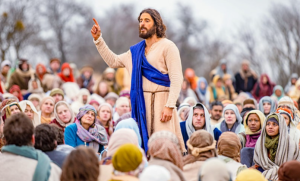
theirs is the kingdom of heaven.
Happy the gentle:
they shall have the earth for their heritage.
Happy those who mourn:
they shall be comforted.
Happy those who hunger and thirst for what is right:
they shall be satisfied.
Happy the merciful:
they shall have mercy shown them.
Happy the pure in heart:
they shall see God.
Happy the peacemakers:
they shall be called sons of God.
Happy those who are persecuted in the cause of right:
theirs is the kingdom of heaven.
‘Happy are you when people abuse you and persecute you and speak all kinds of calumny against you on my account. Rejoice and be glad, for your reward will be great in heaven.’
REFLECTION
It is hard to be a peacemaker in an age of conflict and division, but this is just what we are all called to be. One of the best ways for us Christians to be peacemakers is, as Pope Leo says, ‘to love and nurture fraternity’.
‘Fraternity’, the Pope points out, ‘stems from something deeply human.’ As he suggests, ‘it is certain that our humanity is best fulfilled when we exist and live together.’ Fraternity is a calling, written in our being by our Maker.
Jesus shows us how to fulfil that calling. As the Pope says, ‘to overcome the shadows that threaten it, we need to go to the source, and above all to draw light and strength from Him who alone frees us from the poison of enmity.’
Following his predecessor, Pope Francis, Pope Leo also encourages us to look to the witness of St Francis of Assisi whose approach to others was ‘the inclusive way’. St Francis of Assisi ‘placed all human beings on the same level, precisely because he recognised them in their common destiny of dignity, dialogue, welcome and salvation.’
As the Pope affirms, the welcoming of others signifies ‘a universal fraternity’, and thereby ‘expresses an essential feature of Christianity’.
Jesus’ call to his followers is to become a blessing for others, proclaimers ‘of the Good News destined for the salvation of all.’
by Nick Brodie
[Quotes from General Audience, 12 November 2025: https://www.vatican.va/content/leo-xiv/en/audiences/2025/documents/20251112-udienza-generale.html]