Entrance Antiphon
When he calls on me, I will answer him;
I will deliver him and give him glory,
I will grant him length of days.
First Reading: Genesis 2:7-9; 3:1-7. A reading from the book of Genesis
Creation of our first parents, and sin.
The Lord God fashioned man of dust from the soil. Then he breathed into his nostrils a breath of life, and thus man became a living being.
The Lord God planted a garden in Eden which is in the east, and there he put the man he had fashioned. The Lord God caused to spring up from the soil every kind of tree, enticing to look at and good to eat, with the tree of life and the tree of the knowledge of good and evil in the middle of the garden.
The serpent was the most subtle of all the wild beasts that the Lord God had made. It asked the woman, ‘Did God really say you were not to eat from any of the trees in the garden?’ The woman answered the serpent, ‘We may eat the fruit of the trees in the garden. But of the fruit of the tree in the middle of the garden God said, “You must not eat it, nor touch it, under pain of death”.’ Then the serpent said to the woman, ‘No! You will not die! God knows in fact that on the day you eat it your eyes will be opened and you will be like gods, knowing good and evil.’ The woman saw that the tree was good to eat and pleasing to the eye, and that it was desirable for the knowledge that it could give. So she took some of its fruit and ate it. She gave some also to her husband who was with her, and he ate it. Then the eyes of both of them were opened and they realised that they were naked. So they sewed fig-leaves together to make themselves loin-cloths.
Responsorial Psalm: Be merciful, O Lord, for we have sinned.
- Have mercy on me, God, in your kindness.
In your compassion blot out my offence.
O wash me more and more from my guilt
and cleanse me from my sin. (R.)
- My offences truly I know them;
my sin is always before me.
Against you, you alone, have I sinned;
what is evil in your sight I have done. (R.)
- A pure heart create for me, O God,
put a steadfast spirit within me.
Do not cast me away from your presence,
nor deprive me of your holy spirit. (R.)
- Give me again the joy of your help;
with a spirit of fervour sustain me.
O Lord, open my lips
and my mouth shall declare your praise. (R.)
Second Reading: Romans 5:12-19. A reading from the letter of St Paul to the Romans
Where sin increased, there grace abounded all the more.
Sin entered the world through one man, and through sin death, and thus death has spread through the whole human race because everyone has sinned. Sin existed in the world long before the Law was given. There was no law and so no one could be accused of the sin of ‘law-breaking’, yet death reigned over all from Adam to Moses, even though their sin, unlike that of Adam, was not a matter of breaking a law.
Adam prefigured the One to come, but the gift itself considerably outweighed the fall. If it is certain that through one man’s fall so many died, it is even more certain that divine grace, coming through the one man, Jesus Christ, came to so many as an abundant free gift. The results of the gift also outweigh the results of one man’s sin: for after one single fall came judgement with a verdict of condemnation, now after many falls comes grace with its verdict of acquittal. If it is certain that death reigned over everyone as the consequence of one man’s fall, it is even more certain that one man, Jesus Christ, will cause everyone to reign in life who receives the free gift that he does not deserve, of being made righteous. Again, as one man’s fall brought condemnation on everyone, so the good act of one man brings everyone life and makes them justified. As by one man’s disobedience many were made sinners, so by one man’s obedience many will be made righteous.
Gospel Acclamation: Praise to you, Lord Jesus Christ, king of endless glory! No one lives on bread alone, but on every word that comes from the mouth of God. Praise to you, Lord Jesus Christ, king of endless glory!
Gospel: Matthew 4:1-11. A reading from the holy Gospel according to Matthew
Jesus fasted for forty days and nights.
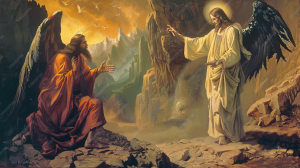
Jesus was led by the Spirit out into the wilderness to be tempted by the devil. He fasted for forty days and forty nights, after which he was very hungry, and the tempter came and said to him, ‘If you are the Son of God, tell these stones to turn into loaves.’ But he replied, ‘Scripture says:
Man does not live on bread alone
but on every word that comes from the mouth of God.’
The devil then took him to the holy city and made him stand on the parapet of the Temple. ‘If you are the Son of God,’ he said, ‘throw yourself down; for scripture says:
He will put you in his angels’ charge,
and they will support you on their hands
in case you hurt your foot against a stone.’
Jesus said to him, ‘Scripture also says:
You must not put the Lord your God to the test.’
Next, taking him to a very high mountain, the devil showed him all the kingdoms of the world and their splendour. ‘I will give you all these’, he said, ‘if you fall at my feet and worship me.’ Then Jesus replied, ‘Be off, Satan! For scripture says:
You must worship the Lord your God,
and serve him alone.’
Then the devil left him, and angels appeared and looked after him.
REFLECTION
by Nick Brodie (Leo’s Lens)
‘Our Christian faith, founded upon Christ’s Paschal mystery,’ Pope Leo says, ‘helps us to experience … hope for the future.’ We are called to be a people who are open to ‘looking forward towards the goal of our journey, towards the safe harbour that God has promised us, towards the unending feast that awaits us.’
‘This final destination, this banquet around which the Lord will gather us,’ the Pope reflects ‘will be an encounter of love.’
With this in mind, we might do well to start our Lenten journey by reflecting that our purpose is love, our goal is love, indeed our innermost calling – is love.
‘For it was out of love that God created us,’ the Pope continues, ‘through the love of his Son that he saves us from death, and in the joy of that same love, he desires that we live forever with him.’
‘For this reason,’ the Pope reflects, ‘whenever we dwell in love and show charity to others, especially the weakest and most needy, then we can journey towards our goal.’ In doing so, we are manifesting God’s love in the world.
‘Love conquers death’, the Pope reminds us, adding that ‘if we journey together in charity, our very lives become a prayer rising up to God.’