Entrance Antiphon
O come, let us worship God
and bow low before the God who made us,
for he is the Lord our God.
First Reading. Isaiah 58:7-10. A reading from the prophet Isaiah
Your light will shine like the dawn.
Thus says the Lord:
Share your bread with the hungry,
and shelter the homeless poor,
clothe the man you see to be naked
and turn not from your own kin.
Then will your light shine like the dawn
and your wound be quickly healed over.
Your integrity will go before you
and the glory of the Lord behind you.
Cry, and the Lord will answer;
call, and he will say, ‘I am here.’
If you do away with the yoke,
the clenched fist, the wicked word,
if you give your bread to the hungry,
and relief to the oppressed,
your light will rise in the darkness,
and your shadows become like noon.
Responsorial Psalm: A light rises in the darkness for the upright.
- He is a light in the darkness for the upright:
he is generous, merciful and just.
The good man takes pity and lends,
he conducts his affairs with honour. (R.)
- The just man will never waver:
he will be remembered for ever.
He has no fear of evil news;
with a firm heart he trusts in the Lord. (R.)
- With a steadfast heart he will not fear;
open-handed, he gives to the poor;
his justice stands firm for ever.
His head will be raised in glory. (R.)
Second Reading: 1 Corinthians 2:1-5. A reading from the first letter of St Paul to the Corinthians
I came to you to proclaim Christ crucified.
When I came to you, brothers, it was not with any show of oratory or philosophy, but simply to tell you what God had guaranteed. During my stay with you, the only knowledge I claimed to have was about Jesus, and only about him as the crucified Christ. Far from relying on any power of my own, I came among you in great ‘fear and trembling’ and in my speeches and the sermons that I gave, there were none of the arguments that belong to philosophy; only a demonstration of the power of the Spirit. And I did this so that your faith should not depend on human philosophy but on the power of God.
Gospel Acclamation: Alleluia, alleluia! I am the light of the world, says the Lord; the man who follows me will have the light of life. Alleluia!
Gospel: Matthew 5:13-16. A reading from the holy Gospel according to Matthew
You are the light of the world.
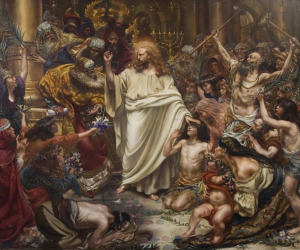 Jesus said to his disciples: ‘You are the salt of the earth. But if salt becomes tasteless, what can make it salty again? It is good for nothing, and can only be thrown out to be trampled underfoot by men.
‘You are the light of the world. A city built on a hill-top cannot be hidden. No one lights a lamp to put it under a tub; they put it on the lamp-stand where it shines for everyone in the house. In the same way your light must shine in the sight of men, so that, seeing your good works, they may give the praise to your Father in heaven.’
Reflection
Education is not only the transmission of content,’ Pope Leo says, ‘but also the learning of virtues. It forms citizens capable of serving and believers capable of witnessing, men and women who are freer, no longer alone.’
Making these comments, the Pope wants us to recapture the true core of the Church’s mission to educate.
He encourages us to make sure our schools become ‘an environment in which faith, culture and life intertwine … a living environment in which the Christian vision permeates every discipline and every interaction.’
But he also notes what takes place outside of schools and universities. The family, he reminds us, ‘remains the first place of education’.
In these changing times, he suggests, we must avoid any ‘technophobia’ that would see us withdraw from opportunities to put forth the Christian message – not only by teaching, but first and foremost by witness.
We do well then, to foster ‘an educational style that promotes respect, personalised accompaniment, discernment and the development of all the human dimensions.’ We should also embrace an educational mindset that ‘is fulfilled and strengthened also through the contemplation of Creation’.
At certain moments, we are all educators. We therefore have an important vocation to, as the Pope puts it, ‘cultivate a heart that listens, a gaze that encourages, and an intelligence that discerns.’
Nick Brodie