Entrance Antiphon
I have risen, and I am with you still, alleluia.
You have laid your hand upon me, alleluia.
Too wonderful for me, this knowledge, alleluia, alleluia.
First Reading: Acts of the Apostles 10:34. 37-43. A reading from the Acts of the Apostles
We have eaten and drunk with him after his resurrection from the dead.
Peter addressed Cornelius and his household: ‘You must have heard about the recent happenings in Judaea; about Jesus of Nazareth and how he began in Galilee, after John had been preaching baptism. God had anointed him with the Holy Spirit and with power, and because God was with him, Jesus went about doing good and curing all who had fallen into the power of the devil. Now I, and those with me, can witness to everything he did throughout the countryside of Judaea and in Jerusalem itself: and also to the fact that they killed him by hanging him on a tree, yet three days afterwards God raised him to life and allowed him to be seen, not by the whole people but only by certain witnesses God had chosen beforehand. Now we are those witnesses – we have eaten and drunk with him after his resurrection from the dead – and he has ordered us to proclaim this to his people and to tell them that God has appointed him to judge everyone, alive or dead. It is to him that all the prophets bear this witness: that all who believe in Jesus will have their sins forgiven through his name.’
Responsorial Psalm: This is the day the Lord has made; let us rejoice and be glad.
- Give thanks to the Lord for he is good,
for his love has no end.
Let the sons of Israel say:
‘His love has no end.’ (R.)
- The Lord’s right hand has triumphed;
his right hand raised me up.
I shall not die, I shall live
and recount his deeds. (R.)
- The stone which the builders rejected
has become the corner stone.
This is the work of the Lord,
a marvel in our eyes. (R.)
Second Reading: Colossians 3:1-4. A reading from the letter of St Paul to the Colossians
Look for the things that are in heaven, where Christ is.
Since you have been brought back to true life with Christ, you must look for the things that are in heaven, where Christ is, sitting at God’s right hand. Let your thoughts be on heavenly things, not on the things that are on the earth, because you have died, and now the life you have is hidden with Christ in God. But when Christ is revealed – and he is your life – you too will be revealed in all your glory with him.
Sequence
The sequence is said or sung on this day. On the weekdays of the Octave of Easter, its use is optional.
Christians, to the Paschal Victim offer sacrifice and praise.
The sheep are ransomed by the Lamb;
and Christ, the undefiled,
hath sinners to his Father reconciled.
Death with life contended: combat strangely ended!
Life’s own Champion, slain, yet lives to reign.
Tell us, Mary: say what thou didst see upon the way.
The tomb the Living did enclose;
I saw Christ’s glory as he rose!
The angels there attesting;
shroud with grave-clothes resting.
Christ, my hope, has risen: he goes before you into Galilee.
That Christ is truly risen from the dead we know.
Victorious king, thy mercy show!
Gospel Acclamation: Alleluia, alleluia! Christ has become our paschal sacrifice; let us feast with joy in the Lord. Alleluia!
Gospel: John 20:1-9. A reading from the holy Gospel according to John
The teaching of scripture is that he must rise from the dead.
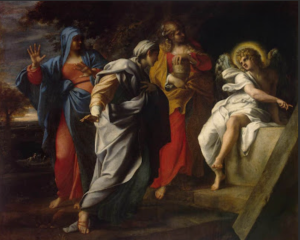
It was very early on the first day of the week and still dark, when Mary of Magdala came to the tomb. She saw that the stone had been moved away from the tomb and came running to Simon Peter and the other disciple, the one Jesus loved. ‘They have taken the Lord out of the tomb’ she said ‘and we don’t know where they have put him.’
So Peter set out with the other disciple to go to the tomb. They ran together, but the other disciple, running faster than Peter, reached the tomb first; he bent down and saw the linen cloths lying on the ground, but did not go in. Simon Peter who was following now came up, went right into the tomb, saw the linen cloths on the ground, and also the cloth that had been over his head; this was not with the linen cloths but rolled up in a place by itself. Then the other disciple who had reached the tomb first also went in; he saw and he believed. Till this moment they had failed to understand the teaching of scripture, that he must rise from the dead.
Reflection
by Nick Brodie (Leo’s Lens)
‘Jesus reveals God to us’, says Pope Leo XIV, ‘with his own true and integral humanity.’ This mystery underpins our Christian calling, and makes the Resurrection an invitation.
‘In order to know God in Christ,’ the Pope suggests, ‘we must welcome his integral humanity.’ This means recognising Christ’s humanness as well as his divinity. Hard as it might be to understand, this is the ancient mystery we profess.
The implications of this are profound. ‘It is not only the death and resurrection of Jesus that saves us and calls us together,’ the Pope explains, ‘but his very person: the Lord who becomes incarnate, is born, heals, teaches, suffers, dies, rises again and remains among us.’
‘Therefore,’ the Pope continues, ‘to honour the greatness of the Incarnation, it is not enough to consider Jesus as the channel of transmission of intellectual truths.’ Certainly, Jesus is our truest teacher, but he is so much more than a teacher from the past.
As the Pope points out, ‘Jesus himself invites us to share his perception of reality.’ Seeing the world through human eyes, Our Risen Lord invites us to see it through his.