Entrance Antiphon
God is in his holy place,
God who unites those who dwell in his house;
he himself gives might and strength to his people.
First Reading: 1 Kings 3:5.7-12. A reading from the first book of the Kings
You have asked for wisdom.
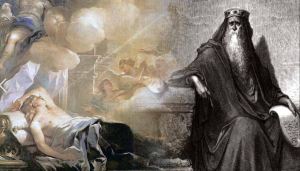
The Lord appeared to Solomon in a dream and said, ‘Ask what you would like me to give you.’ Solomon replied, ‘Lord, my God, you have made your servant king in succession to David my father. But I am a very young man, unskilled in leadership. Your servant finds himself in the midst of this people of yours that you have chosen, a people so many its numbers cannot be counted or reckoned. Give your servant a heart to understand how to discern between good and evil, for who could govern this people of yours that is so great?’ It pleased the Lord that Solomon should have asked for this. ‘Since you have asked for this’ the Lord said ‘and not asked for long life for yourself or riches or the lives of your enemies, but have asked for a discerning judgement for yourself, here and now I do what you ask. I give you a heart wise and shrewd as none before you has had and none will have after you.’
Responsorial Psalm: Lord, I love your commands.
- My part, I have resolved, O Lord,
is to obey your word.
The law from your mouth means more to me
than silver and gold. (R.)
- Let your love be ready to console me
by your promise to your servant.
Let your love come to me and I shall live
for your law is my delight. (R.)
- That is why I love your commands
more than finest gold.
That is why I rule my life by your precepts:
I hate false ways. (R.)
- Your will is wonderful indeed;
therefore I obey it.
The unfolding of your word gives light
and teaches the simple. (R.)
Second Reading: Romans 8:28-30. A reading from the letter of St Paul to the Romans
He predestined us to become true images of his Son.
We know that by turning everything to their good God co-operates with all those who love him, with all those that he has called according to his purpose. They are the ones he chose specially long ago and intended to become true images of his Son, so that his Son might be the eldest of many brothers. He called those he intended for this; those he called he justified, and with those he justified he shared his glory.
Gospel Acclamation: Alleluia, alleluia! Blessed are you, Father, Lord of heaven and earth; you have revealed to little ones the mysteries of the kingdom. Alleluia!
Gospel: Matthew 13:44-52. A reading from the holy Gospel according to Matthew
He sells everything he owns and buys the field.
Jesus said to the crowds, ‘The kingdom of heaven is like treasure hidden in a field which someone has found; he hides it again, goes off happy, sells everything he owns and buys the field.
‘Again, the kingdom of heaven is like a merchant looking for fine pearls; when he finds one of great value he goes and sells everything he owns and buys it.
‘Again, the kingdom of heaven is like a dragnet cast into the sea that brings in a haul of all kinds. When it is full, the fishermen haul it ashore; then, sitting down, they collect the good ones in a basket and throw away those that are no use. This is how it will be at the end of time: the angels will appear and separate the wicked from the just to throw them into the blazing furnace where there will be weeping and grinding of teeth.
‘Have you understood all this?’ They said, ‘Yes.’ And he said to them, ‘Well, then, every scribe who becomes a disciple of the kingdom of heaven is like a householder who brings out from his storeroom things both new and old.’
REFLECTION
by Nick Brodie (Leo’s Lens)
Pope Leo reminds us that ‘the Lord continues to go before us in history, and the Church is called first and foremost to recognise his presence.’ If we truly believe this, then we have our treasure already! But with it comes responsibility.
As the Pope points out, we are called to work for unity. ‘Communion is never a result that is achieved once and for all,’ he points out. Rather, ‘it remains a daily conversion, which takes shape in prayer, and through concrete actions, relationships of trust, and a willingness to listen to one another.’
Similarly, we are called to work for the common good. This ‘does not arise spontaneously,’ he says, ‘but requires shared responsibility.’ For we Christians, the Pope adds, ‘this takes on a very specific form: a synodal style at the service of the mission of the Kingdom.’
Elaborating further, the Pope highlights how ‘synodality is an attitude, an openness, a willingness to understand.’ It is an approach to serving the Kingdom, he reminds Church leaders, that helps us ‘to listen to what is emerging in the Churches, to recognise the signs of hope that often grow in silence.’