
Entrance Antiphon
As for me, in justice I shall behold your face;
I shall be filled with the vision of your glory.
First Reading: Isaiah 55:10-11. A reading from the prophet Isaiah
The rain makes the earth fruitful.
Thus says the Lord: ‘As the rain and the snow come down from the heavens and do not return without watering the earth, making it yield and giving growth to provide seed for the sower and bread for the eating, so the word that goes from my mouth does not return to me empty, without carrying out my will and succeeding in what it was sent to do.’
Responsorial Psalm: The seed that falls on good ground will yield a fruitful harvest.
- You care for the earth, give it water,
you fill it with riches.
Your river in heaven brims over
to provide its grain. (R.)
- And thus you provide for the earth;
you drench its furrows,
you level it, soften it with showers,
you bless its growth. (R.)
- You crown the year with your goodness.
Abundance flows in your steps,
in the pastures of the wilderness it flows. (R.)
- The hills are girded with joy,
the meadows covered with flocks,
the valleys are decked with wheat.
They shout for joy, yes, they sing. (R.)
Second Reading: Romans 8:18-23. A reading from the letter of St Paul to the Romans
All creation is waiting for the revelation of the children of God.
I think that what we suffer in this life can never be compared to the glory, as yet unrevealed, which is waiting for us. The whole creation is eagerly waiting for God to reveal his sons. It was not for any fault on the part of creation that it was made unable to attain its purpose, it was made so by God; but creation still retains the hope of being freed, like us, from its slavery to decadence, to enjoy the same freedom and glory as the children of God. From the beginning till now the entire creation, as we know, has been groaning in one great act of giving birth; and not only creation, but all of us who possess the first-fruits of the Spirit, we too groan inwardly as we wait for our bodies to be set free.
Gospel Acclamation: Alleluia, alleluia! The seed is the word of God, Christ is the sower; all who come to him will live for ever. Alleluia!
Gospel: Matthew 13:1-23. A reading from the holy Gospel according to Matthew
A sower went out to sow.
Jesus left the house and sat by the lakeside, but such crowds gathered round him that he got into a boat and sat there. The people all stood on the beach, and he told them many things in parables.
He said, ‘Imagine a sower going out to sow. As he sowed, some seeds fell on the edge of the path, and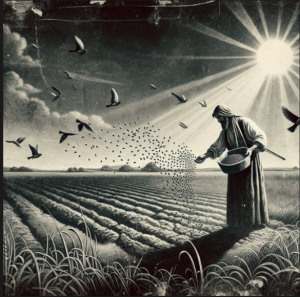 the birds came and ate them up. Others fell on patches of rock where they found little soil and sprang up straight away, because there was no depth of earth; but as soon as the sun came up they were scorched and, not having any roots, they withered away. Others fell among thorns, and the thorns grew up and choked them. Others fell on rich soil and produced their crop, some a hundredfold, some sixty, some thirty. Listen, anyone who has ears!’
Then the disciples went up to him and asked, ‘Why do you talk to them in parables?’ ‘Because’ he replied ‘the mysteries of the kingdom of heaven are revealed to you, but they are not revealed to them. For anyone who has will be given more, and he will have more than enough; but from anyone who has not, even what he has will be taken away. The reason I talk to them in parables is that they look without seeing and listen without hearing or understanding. So in their case this prophecy of Isaiah is being fulfilled:
You will listen and listen again, but not understand,
see and see again, but not perceive.
For the heart of this nation has grown coarse,
their ears are dull of hearing,
and they have shut their eyes,
for fear they should see with their eyes,
hear with their ears,
understand with their heart,
and be converted
and be healed by me.
‘But happy are your eyes because they see, your ears because they hear! I tell you solemnly, many prophets and holy men longed to see what you see, and never saw it; to hear what you hear, and never heard it.
‘You, therefore, are to hear the parable of the sower. When anyone hears the word of the kingdom without understanding, the evil one comes and carries off what was sown in his heart: this is the man who received the seed on the edge of the path. The one who received it on patches of rock is the man who hears the word and welcomes it at once with joy. But he has no root in him, he does not last; let some trial come, or some persecution on account of the word, and he falls away at once. The one who received the seed in thorns is the man who hears the word, but the worries of this world and the lure of riches choke the word and so he produces nothing. And the one who received the seed in rich soil is the man who hears the word and understands it; he is the one who yields a harvest and produces now a hundredfold, now sixty, now thirty.’
REFLECTION
by Dianne Bergant CSA
The readings for this Sunday call us to self-examination. The gospel describes various levels of receptivity, the willingness to allow ourselves to receive from another, to be influenced by another, perhaps even to be transformed. The more independent we are, the less likely we will be open to others and, consequently, less receptive to their ideas. By definition disciples are receptive to the one they follow. To be a disciple of Jesus requires receptivity, so it is important that we scrutinise ourselves to discover the extent to which we are open. To what should we be receptive? To the words of Scripture, the words of the liturgy, the words of the sacraments, the living tradition of the community. God’s word is sown in many forms and under many guises. It makes little difference who sows the seed. How will we receive it?
Besides the word of God, the readings speak of the world of God. The people of biblical times were aware of the revelation of God in and through the natural world. Isaiah teaches about the effectiveness of the word of God through the metaphor of rain. The psalmist uses the natural world to describe God’s work of salvation. Paul claims that eschatological fulfilment will include all of creation. Finally, Jesus’ parables are rooted in stories about nature. We cannot afford to close our eyes to the needs of the natural world, or stop our ears to the cries of the earth, or harden our hearts to the world of which we are a part, for the word of God will accomplish the end for which God sent it.